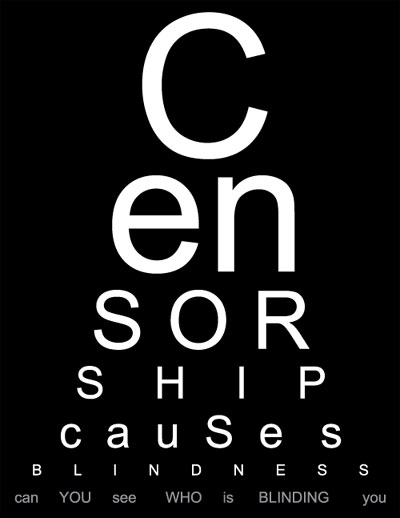
Censorship
What is censorship?
"Censorship occurs when published or shared works, like books, film, or art work, are kept from public access by restriction or removal from libraries, museums, or other public venues" (Censorship).
Why is this wrong?
The 1st Amendment of the Constitution states that “Congress shall make no law respecting an establishment of religion, or prohibiting the free exercises thereof: or abridging the freedom of speech, or of the press; and to petition the Government for a redress of grievances” (Banned Books Week Set).
When books go through censorship they are 1st challenged and then sometimes banned. What is the difference?
“A challenge is an attempt to remove or restrict materials, based upon the objections of a person or group. A banning is the removal of those materials, challenges do not simply involve a person expressing a point of view: rather, they are an attempt to remove a material from the curriculum or library, thereby restricting the access of others” (Hewes).
History
From ancient times to current day men have used censorship to block the ideas of those they disagree with. "In 360 B.C., Plato described the Ideal Republic: Our first business will be to supervise the making of fable legends; rejecting all which are unsatisfactory...".
In ancient times men would burn the few handwritten books that existed, but with the invention of the printing press by Johann Gutenberg in 1450 book burnings were no longer efficient. Soon after Germany formed the first censorship office and books were again in danger.
The Roman Catholic chuch went went so far as to create a list of banned books called the Index Librorum Prohibitorum with the advance of science and Protestantism in 1559.
The first american book burnings occured in 1650 with the idea of censorship traveling with European settlers.
Anthony Comstock, a post office worker, had a law passed limiting what could be sent in the mail in 1873 and confiscated 120 tons of printed works between 1874 and 1915 (firstamendmentcenter).
Book Banning
What does book banning have to do with censorship?
Today the banning of books in schools and libraries is a major part of censorship. The ALA got 740 reports of books or library materials challenged from 1995-1996 and Judith F. Krug said the actual challenges were probably four times greater (Banned Books Week celebrates).
Large numbers of books are continuing to be challenged and are on the rise, but most challenges aren’t reported. An even smaller number are actually banned (Celebrating).
Why and by whom are books challenged?
“Most frequently, books are challenged because they contain profanity or violence, sex or sex education, homosexuality, witchcraft and the occult, secular humanism, or new age philosophies, portrayals of rebellious children, or politically incorrect, racist or sexist language” (firstamendmentcenter).
Tony Doyle, a librarian at Livingston High School, believes students are intelligent enough to judge reality and make decisions about banned books so should be able to read them (Freedomforum).
“I don’t think we’re ever going to lose the concern about or the horror over sex, not in this country. (But) we are really having a deluge of complaints dealing with witchcraft and future” (Parent).
“In Wrenshall, MN parents were against The Giver being sold at the high school so the school board decided to send home a note instead.”
The Giver was challenged in Cincinnati, OH at Lakota High School but instead of banning it they made students bring written permission from their parents.
In Oklahoma when a parent tried to get The Giver banned because of Occult New Age terms the school committee banned it from being read aloud under 5th grade but kept it. They also told librarians to watch for immature readers and to carry fewer copies.
The Giver was challenged by a parent in Franklin County, Kansas in 1995 because of murder, suicide, and the degradation of motherhood and adolescence; however, it was only taken out of the elementary school libraries (Selected).